
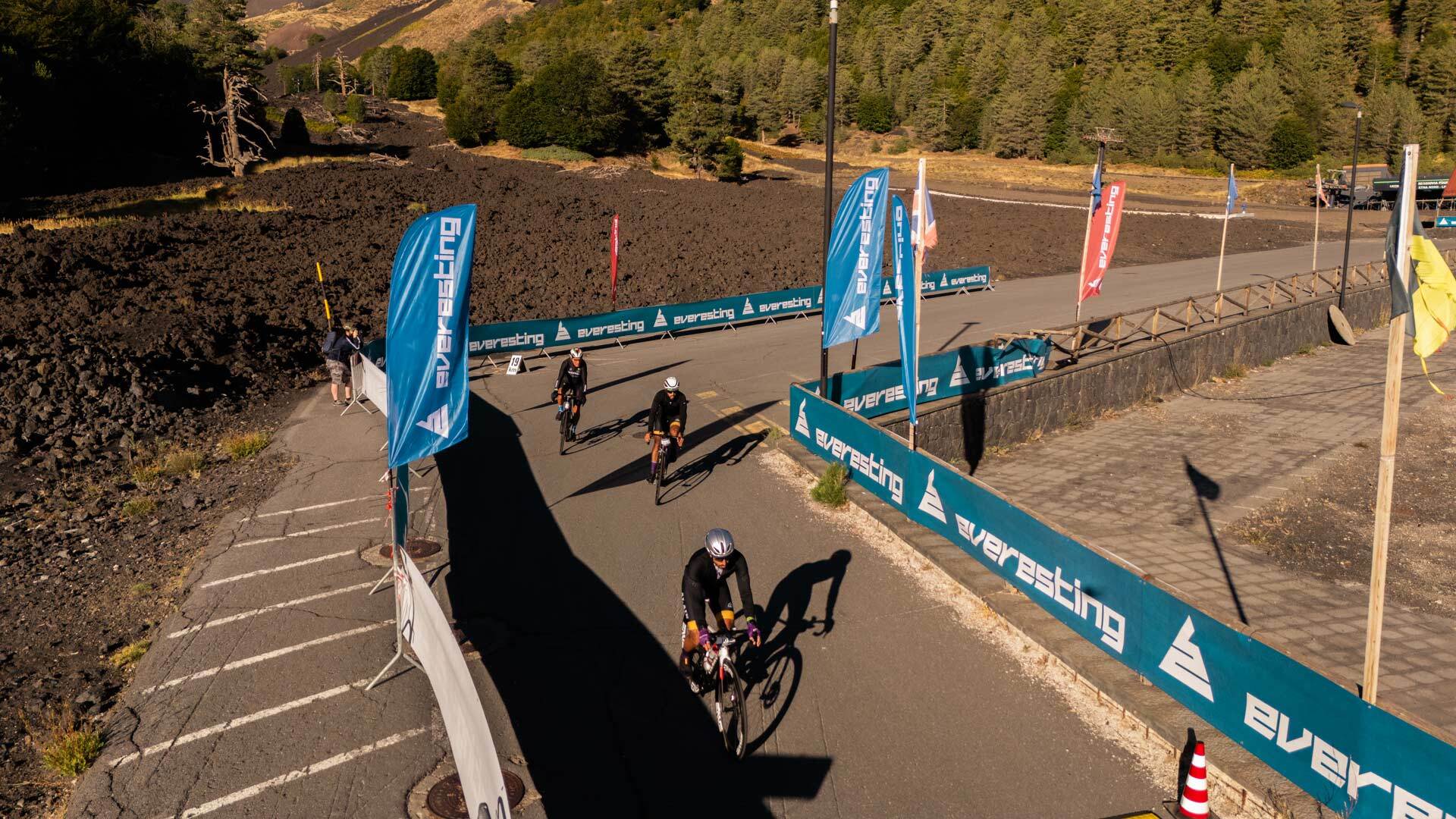
“I could never do an Everesting.”
It is a common reaction among cyclists encountering the challenge for the first time. The numbers alone 8,848 meters of elevation suggest something extreme, almost abstract.
What riders often see is the accumulation of effort like hours on the bike, repeated ascents, the physical strain of climbing and descending the same road again and again. They imagine fatigue building without pause, nutrition becoming difficult, and the mind gradually pushing toward a single question: why continue?
In many ways, Everesting begins long before the first pedal stroke. It starts in the imagination, where the full scale of the effort is perceived all at once.
Yet the reality unfolds differently.
An Everesting is never experienced as a single, overwhelming block. It is a sequence. One repetition after another. What feels unmanageable when viewed as a whole becomes approachable when broken down into parts. The difficulty lies not in the first ascent, nor the second, but in the tendency to project the entire effort before it has even begun.
Once inside the challenge, perception shifts because there are moments of control and others of struggle, phases where the effort feels sustainable and others where it becomes uncertain. Riders do not “ride Everest” in a single effort. They move from one point to the next, from one corner to another, maintaining rhythm rather than chasing the total.
As Everesting has evolved into a race format, this psychological barrier has become increasingly clear. Many cyclists are drawn to the idea, yet hesitate before fully engaging because of how the challenge is perceived.
This is where the introduction of categories has reshaped the experience.
By offering different formats, the core structure remains unchanged. What changes is the scale at which riders enter the effort. From shorter distances to the full Everesting, each format follows the same logic, allowing participants to approach the challenge progressively.
The objective is to transform what appears as a single, insurmountable wall into a sequence that can be managed.
What once felt out of reach begins to take form. One climb follows another, and then another, until the challenge is completed.
Not all at once, but step by step.
