
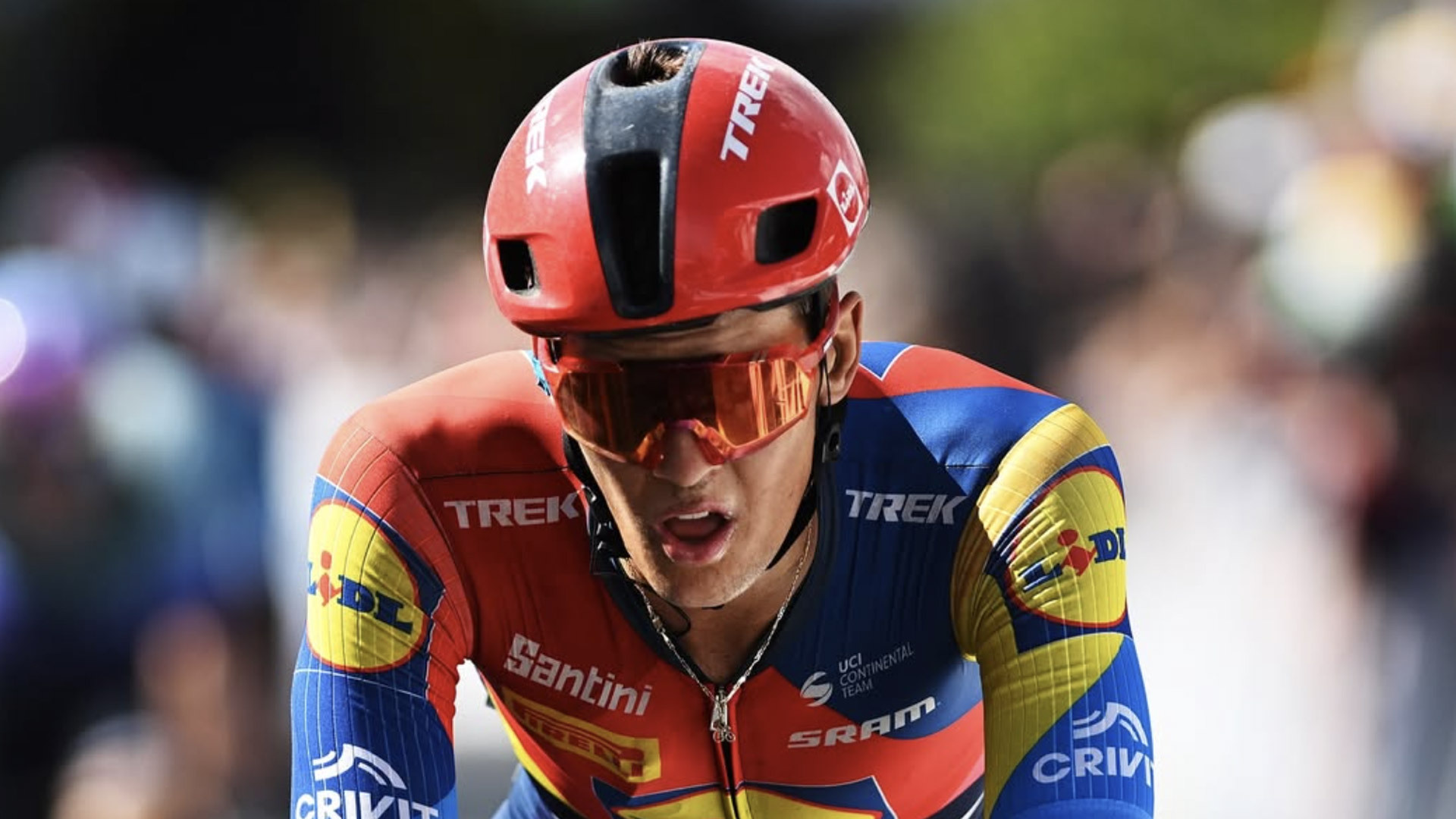
Paul Verbnjak did not learn how to climb on a bike. He comes from a discipline where climbing is the only direction that matters. A ski mountaineer at the highest level, Verbnjak has built his career on vertical racing, World Cup podiums, uphill-only efforts, competitions defined by rhythm, pacing and elevation gain. In a sport with no flat terrain and no real recovery, performance is measured in meters climbed. That is the foundation of his engine.
When he transitions to the bike, that background is immediately visible. His pedal stroke is controlled, his effort steady, his approach measured. Rather than reacting to competitors, he settles into the gradient, riding it with consistency. It is a subtle distinction, but one that defines his style.
In recent years, Verbnjak has brought this identity into cycling, combining road riding with his mountain endurance background. The result is an uncommon profile: a rider with sustained power, natural efficiency on climbs, and the ability to remain composed deep into long efforts.
Terrain like Dobratsch reflects these qualities. It is not a climb that reveals its difficulty immediately, but one that builds over time. As the distance increases, the effort becomes more selective, rewarding those who can maintain rhythm rather than those who rely on short bursts of intensity.
Verbnjak now joins Everesting as an ambassador, adding a perspective shaped entirely by vertical performance. His experience aligns closely with the nature of the challenge: repeated climbing, sustained output, and the ability to manage effort over extended periods.
In ski mountaineering, success is defined by the ability to go up, efficiently and continuously. On climbs like Dobratsch, the principle remains unchanged.
